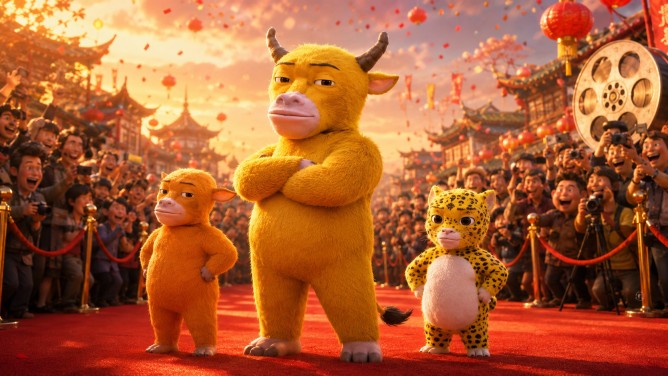
An unexpectedly popular Chinese animated film, “Niu Lai,” which translates to “The Cow is Coming,” has taken the box office by storm despite its low-budget production. The 86-minute movie follows a newborn calf and a skylark as their relationship develops through a surreal dream sequence. Initially released on August 5, the film struggled to attract attention and earned a mere 7,700 yuan in its first 10 days, with fewer than 300 tickets sold across China.
The film’s fortunes shifted dramatically thanks to social media, where users began discussing and ridiculing its unconventional animation, narrative, and overall production quality. This online buzz turned “Niu Lai” into a viral sensation, driving curious audiences to theaters. As a result, the film has now grossed over 14.9 million yuan, positioning it as one of the year’s most surprising box-office successes.
Remarkably, “Niu Lai” was created by just two individuals, Xin Yumeng and Sun Lifang, who took on writing, directing, voice acting, and production duties over a five-year period. The film’s handmade aesthetic starkly contrasts with the polished animation seen in prominent Chinese productions like “Ne Zha 2.”
While some viewers have appreciated the film’s artisanal appearance, particularly in an era where artificial intelligence increasingly influences film production, others have criticized its success. Critics argue that audiences are celebrating subpar filmmaking instead of supporting more ambitious cinematic endeavors.
Nevertheless, “Niu Lai” underscores the power of social media and public curiosity in transforming an obscure film with minimal marketing into an unexpected box-office hit. Despite mixed reactions, the film’s journey highlights the unpredictable nature of audience engagement and the potential for unconventional projects to capture the public’s imagination.