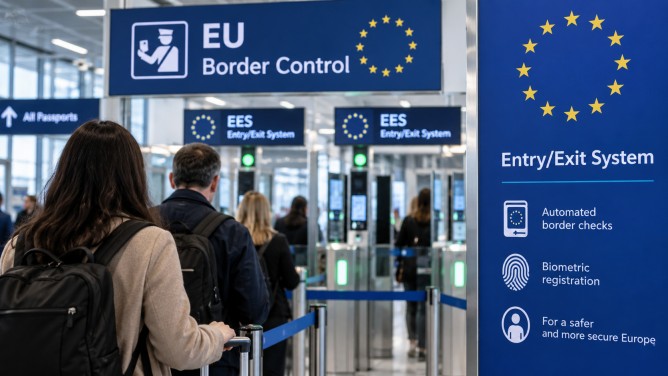
The delay in implementing the European Union’s Entry/Exit System (EES) is causing significant operational challenges at major airports across Europe. As the system requires biometric checks for non-EU travelers entering the Schengen area, airports are experiencing logistical difficulties that could result in longer queues, especially during peak travel periods. The International Air Transport Association has already expressed concerns about the potential for travel disruptions.
The EES, which was launched last October, mandates that travelers’ fingerprints and facial images be recorded upon entry. However, nine countries, including France, Greece, Italy, and Portugal, are postponing full implementation due to technical and operational hurdles. These challenges are most pronounced at busy airports and other key border crossings, where existing infrastructure is struggling to accommodate the new system.
Germany, Malta, the Netherlands, Switzerland, and Belgium have also requested more time to integrate the system fully. While some progress has been made, such as the commencement of biometric checks at Eurostar terminals in Brussels and Antwerp, many airports are still not equipped to handle the requirements. In contrast, Spain has successfully dealt with initial issues and moved forward with the system.
The system has already processed approximately 200 million registrations and prevented around 70,000 entries into the Schengen area. These include individuals lacking the necessary visas, those who have overstayed their welcome, and some using counterfeit documents. Despite these successes, implementation remains uneven, with major hubs like Frankfurt and Schiphol conducting checks while smaller airports lag behind.
To streamline the process, a pre-travel application called “Travel to Europe” is being rolled out, allowing travelers to submit their passport details and facial images before reaching the border. This application is currently operational in Sweden and Portugal, with plans for expansion to other countries. As authorities continue to grapple with these challenges, the full implementation of the EES remains a work in progress, with implications for travel efficiency and border security across Europe.